From AI Interest to Implementation: What Family Offices Need to Do Next
The budget is approved and the pilots are announced. What changes the office is one problem, one owner and written rules before the first test.
I · The gapAn implementation problem, not an awareness one
Family offices do not have an AI-awareness problem. In our conversations with principals, AI is already on the agenda. Many have a board member, a next-generation family member or a CIO pushing for it. Many have already paid for something.
What they have is an implementation problem, a governance problem and a security problem. Those three are the same problem, seen from different chairs.
The gap between interest and organized implementation is now the defining feature of AI in the family office sector. The budget has been approved. Pilots have been announced. Yet ask what has actually changed in how the office operates, and the answer is often a shrug: a few people using a chatbot to draft emails, a subscription nobody owns, and a growing unease about what has already been pasted into public tools.
So the useful question is not "should we use AI?" It is: where should a family office actually begin?
II · Why projects stallWhy family-office AI projects stall

AI projects fail for much the same reasons large ERP projects failed in the 1990s. The technology is rarely the issue. The organization is.
No defined business problem. "We need an AI strategy" is not a problem. "Our quarterly reporting takes eleven days and three people" is. Projects that start with the technology and go looking for a use case tend to find a demo, not a result.
Sensitive, fragmented data. A family office holds an unusually concentrated set of private information: trust deeds, entity structures, medical and family matters, holdings across custodians, decades of correspondence. It sits in five systems, four inboxes and one very experienced executive assistant. AI amplifies whatever data discipline you already have. If that discipline is weak, AI makes it visibly weak.
Uncertainty about privacy. Nobody is quite sure what happens to information once it enters a model. So the cautious freeze, and the curious proceed without asking.
Employees experimenting without policy. This is the real exposure. In the absence of rules, staff make their own. Somebody uploads a term sheet to summarize it. Somebody else pastes a beneficiary list to "tidy up the formatting." No malice, no policy, no record.
Too many tools and no owner. Three subscriptions, two vendors circling, and no single person accountable for the outcome. Ownership is the difference between a project and a hobby.
Expecting transformation. The office that expects AI to change everything in a quarter is the office that abandons it in two. The offices getting results treat AI the way a disciplined CFO treats any operational change: one process, one owner, one measure.
III · First valueWhere AI delivers practical value first
The early applications that pay back first are unglamorous. That is a feature.
Investment and market research. First-pass synthesis of manager letters, filings, sector reports and news across a portfolio. The analyst still forms the view. The analyst no longer spends Monday morning reading four hundred pages to find the twenty that matter.
Document review and summarization. Side letters, LPAs, leases, insurance schedules: structured extraction of key terms, with the original always one click away.
Meeting preparation. A brief built from the last three interactions with a manager, a counterparty or a family member, so the principal walks in informed rather than reminded.
Reporting and data organization. Reconciling custodian statements into a consistent format, flagging anomalies for a human to check.
Administrative workflow. Capital-call tracking, KYC document assembly, subscription paperwork: the repetitive work where errors are expensive and attention is scarce.
Knowledge management. The institutional memory that currently lives in one long-tenured employee's head, captured and searchable.
Internal communications. First drafts of family updates, board packs and policy documents.
Notice what is not on the list. AI should not be making investment decisions, and it should not be making governance decisions. It prepares the decision. A human takes it and is accountable for it. Any vendor who blurs that line is selling you a liability.
IV · PrivacyThe privacy question
Family offices require stricter controls than most institutions, for a simple reason: the data is about people, not just positions. A leaked portfolio is embarrassing. A leaked family structure is a security event.
A workable privacy posture rests on five elements.
Data classification. Not everything is equally sensitive. Public market research is one tier. Portfolio holdings are another. Family members' personal information, trust and estate structures, health matters and physical security details are a third, and that third tier does not enter any external AI system, approved or otherwise.
Approved versus unapproved tools. A short, written list of what staff may use, under which accounts, with which data. Enterprise agreements that contractually exclude training on your data. Personal accounts on public tools are unapproved for anything beyond public information. Full stop.
Access permissions. AI tools inherit the permissions of the person using them, and then some. If your document store is loosely permissioned, an AI assistant will surface documents people were never meant to find. Fix the permissions before you connect the tool.
Human review. Every AI output that leaves the office (to a family member, a counterparty, a regulator) is reviewed by a named person. Not spot-checked. Reviewed.
A record. Which tools, which data, which decisions. When a family member or a regulator asks how a document was produced, the answer should not be "we're not sure."
This is not bureaucracy. It is the same discipline a family office already applies to wire transfers. Nobody considers a two-signature rule an obstacle to paying invoices.
V · FrameworkA practical implementation framework
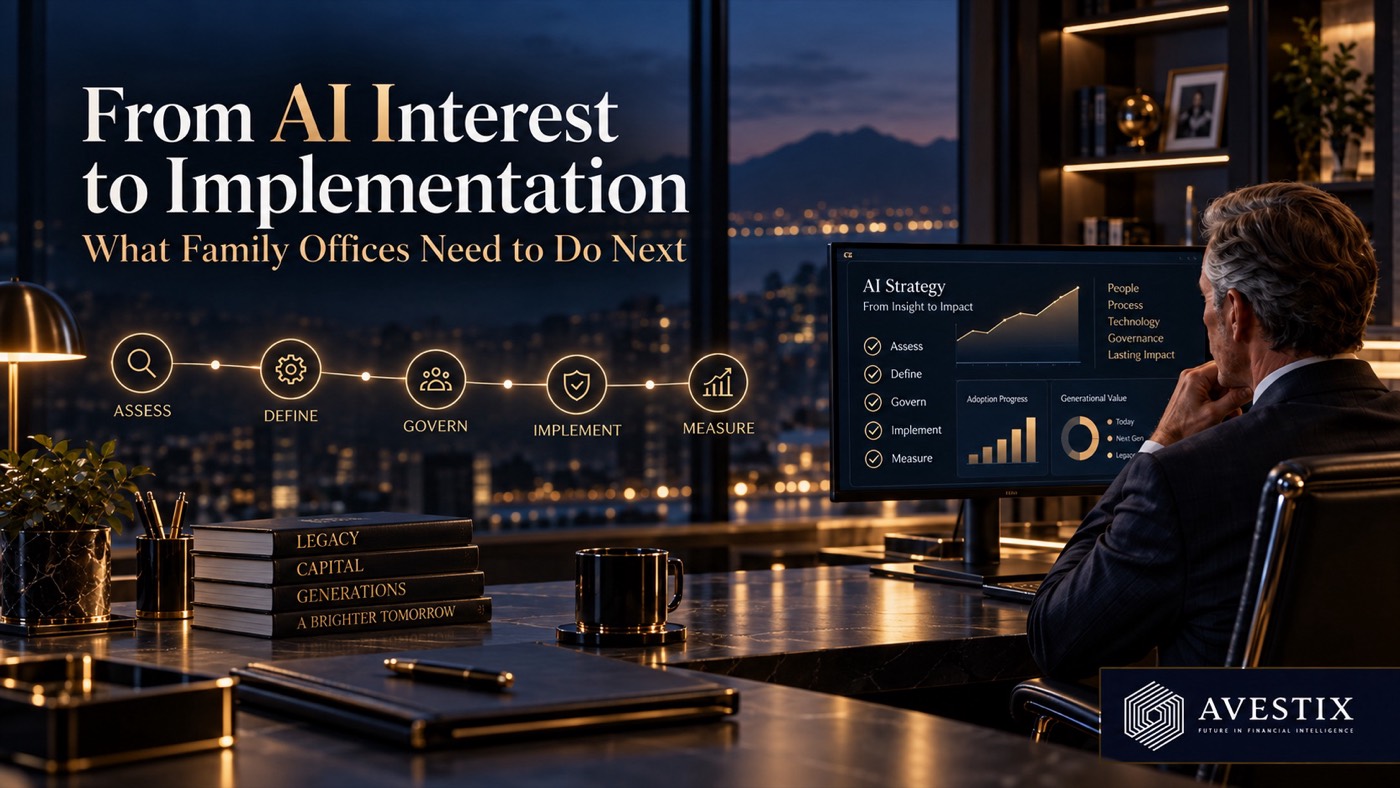
Five steps. In this order.
1. Identify one repetitive problem. Something measurable, frequent and annoying. Reporting. Document intake. Meeting prep. Not "strategy."
2. Appoint a responsible internal owner. One person, with authority and time. Not the vendor. Not a committee.
3. Establish privacy and usage rules before the first test. Classification, approved tools, review requirements. Written, circulated, signed.
4. Test one controlled use case. Bounded data, bounded users, a defined period. Six to eight weeks is a reasonable first test period.
5. Measure the result before expanding. Hours saved, errors reduced, turnaround time. If it did not move a number, do not scale it. Go back to step one.
The order matters. Skipping step three is how an office ends up with an incident instead of a second use case.
VI · SuccessWhat success actually looks like
Success is not "using AI." Any office can claim that. Success is a measurable operational improvement that a principal would recognize without being told an algorithm was involved. For example:
Quarterly reporting that takes four days instead of eleven (illustrative).
A manager meeting brief ready in an hour, not an afternoon (illustrative).
A side-letter term found in seconds rather than reconstructed from memory (illustrative).
Fewer administrative errors in capital-call and KYC processing.
Processes that run the same way regardless of who is on leave.
Principals arriving at decisions better prepared, with the underlying material a click away.
Those are the improvements worth reporting to a family. "We have an AI strategy" is not.
The offices that succeed treat AI as an operating discipline, not a technology purchase. They pick one problem, put one name against it, write the rules before the first test, and measure. The offices still experimenting a year later almost always skipped the ownership step. Nobody was accountable, so nothing was finished.Susan Lindeque, Founder and CEO, Avestix
VII · TogetherWorking it through, together

Frameworks are necessary and insufficient. The hard part of implementation is the specific: which data can go where, which vendor's contract actually says what it claims, what a governance policy looks like when it has to survive a family council.
That is the kind of question most usefully worked through with peers who carry the same weight, which is why AI implementation, governance and security have become a standing theme of the working sessions we run for members of Avestix Frontier, the invitation-only community of Avestix. What is scarce is a small number of people you can think out loud with, who understand that stewarding wealth across generations now includes stewarding the intelligence that runs the office.
The technology will keep improving. The governance has to be built by you.
VIII · FAQFrequently asked questions
How can family offices use AI?
Most productively in research synthesis, document review, meeting preparation, reporting, administrative workflow and knowledge management: the repetitive, information-heavy work that consumes staff time without requiring judgment. AI prepares decisions; it does not take them.
Is AI secure enough for family offices?
The tools can be, under the right agreements and controls. The risk sits less in the technology than in unmanaged use: staff on personal accounts, unclassified data, no review process. Security is a governance outcome, not a vendor feature.
Where should a family office begin with AI?
With one measurable, repetitive problem, one internal owner and a written usage policy, before any tool is selected.
Can AI make investment decisions?
No, and a family office should not want it to. AI can accelerate research and surface information; the investment decision and the accountability for it remain human.
What information should not be entered into AI tools?
Family members' personal information, trust and estate structures, health matters, physical security details and any data covered by confidentiality obligations should not enter external AI systems. Portfolio and holdings data should enter only approved enterprise tools with contractual data protections.
How should a family office create an AI policy?
Start with data classification, a short list of approved tools, access permissions, a human-review requirement for anything leaving the office, and a record of use. Keep it to two pages, sign it and revisit it quarterly.
For education and discussion. Not tax, legal or investment advice. Frontier teaches; it does not manage money. Read the disclosure.
Plan the structure with families doing the same
Invitation only.