Beyond the Ballroom: Why Family-Office Work Belongs in Smaller Rooms
Large conferences are good for visibility. They are the wrong room for succession, family conflict or a stalled project. What a working format needs instead.
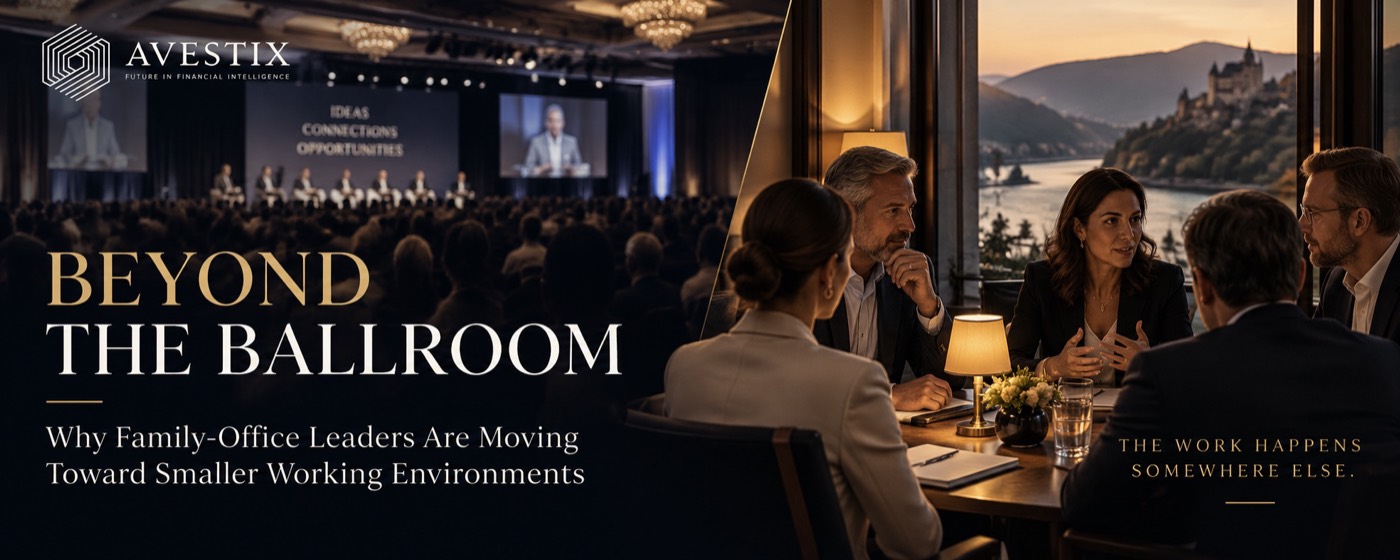
I · The ballroomWhat large conferences still do well
You know the format. Eight hundred delegates. A keynote at nine, four panels before lunch, each with five people and thirty-five minutes. A sponsor lounge. An exhibition hall. Coffee breaks where you have six minutes to decide whether the person in front of you is worth a follow-up email you will probably not send. By day two the lanyard is in your pocket, the schedule is a blur, and you have a stack of business cards with no memory attached to them.
These events are not worthless. But it is worth being clear about what they are for and what they are not for, because many family-office leaders are drawing that line for themselves and voting with their calendars.
To be fair to the ballroom:
Large conferences provide market visibility. If you are launching a fund, a platform or a practice, there is no substitute for being seen by several hundred people at once.
They provide broad networking. The sheer density of people means that somewhere in the room is the introduction you need, even if finding it is a matter of luck.
They provide industry education, especially for people newer to the sector. A well-run conference is an efficient way to hear what the market is saying about itself.
They build brand awareness, for sponsors and speakers alike. And they expose you to ideas from outside your immediate circle: a panelist from an adjacent sector, a regulator you would never otherwise hear from.
None of that is trivial. A family office that never attends a major conference will slowly lose touch with the market. The question is not whether to attend. It is what you expect to happen there.
II · Where it falls shortWhere the traditional model falls short
Here is what does not happen in a ballroom: the conversations that actually matter.
Consider the problems that keep a principal awake. Succession, and the sibling who thinks it is theirs. A family conflict that is starting to leak into the operating business. A governance failure that nobody outside the family knows about yet. A security incident. An investment mistake that cost real money and has not been fully disclosed to the family. The realization that the office does not have the internal capacity for what the family now needs. A technology implementation that has stalled with a vendor who over-promised.
These are the issues where a peer's experience would be worth more than any panel. And they are precisely the issues nobody raises in a room of eight hundred people, many of whom are selling something.
The format itself prevents it. A thirty-five-minute panel produces generalities because generalities are safe in public. Networking breaks produce introductions, not trust. Sponsor-driven agendas produce content that serves the sponsor. And the sheer number of people means there is no accountability: you will never see most of them again, so nothing said carries weight and nothing promised needs to be kept.
Family-office issues are complex, sensitive and specific. Large conferences are designed to be simple, public and general. The mismatch is structural, not a matter of better programming.
III · Smaller groupsWhy smaller groups change the conversation
Shrink the room to a few dozen people, extend the time to several days, and something different happens. We have seen it repeatedly.
Repeated interaction builds trust that a single exchange cannot. The person you were guarded with on the first morning is the person you are asking for advice by the third evening, because you have now seen how they think across a dozen conversations.
There is time for context. A real problem takes twenty minutes to explain properly: the family history, the structure, the personalities. In a small working session that time exists. In a panel Q&A it does not.
Accountability appears. When you tell a small group what you intend to do, and you will see them again, you are more likely to do it.
Peer-to-peer discussion replaces expert-to-audience broadcast. The most valuable person in the room is usually not the speaker. It is the principal two seats over who solved your problem four years ago.
The pressure to perform disappears. Nobody is playing to an audience. People say what they actually think, including "I got that wrong."
And the conversation continues informally, over dinner, on a walk, in the hour after the session that turns out to be the most productive hour of the day.
IV · Attending vs workingThe difference between attending and working
The shift is not from large events to small ones. It is from attending to working.
Listening to a panel on succession is attending. Sitting with four other families and applying a decision-rights framework to your own situation is working.
Collecting contacts is attending. Building a relationship over several days, with the intention of continuing it, is working.
Discussing trends in private credit is attending. Bringing a specific allocation question to people who have already made that allocation, and leaving with an answer, is working.
Receiving information is attending. Leaving with a written action plan and someone who will ask you about it in three months is working.
Principals have limited time and no shortage of information. What they lack is a place to do the work (the thinking, the testing, the candid comparison) that they cannot do alone and cannot do in public.
V · Designing the roomWhat a properly designed working environment needs
Small does not automatically mean useful. A badly designed retreat is a bad conference with fewer people. The formats that work share a set of principles.
Carefully selected participants. Not whoever pays. People chosen for what they bring to the room and what they can safely hear in it: comparable scale, comparable seriousness, complementary experience.
Clear confidentiality expectations. Stated at the outset and taken seriously. Without them, candor is impossible and the format collapses into a conference.
Limited commercial pitching. Sponsors and partners can be present; they cannot own the agenda. The moment a working session becomes a sales opportunity, every principal in the room reverts to guarded mode.
Facilitated sessions. Someone whose job is to keep the discussion honest, structured and moving, not a moderator reading questions off a card.
Time for informal interaction. Shared meals, unscheduled hours, time away from the schedule. The informal time is not a break from the work. It is where a large share of the work happens.
Practical outputs. Each session should end with something written: a decision, a framework applied, a question answered, a next step owned.
Follow-up after the gathering. The relationships and the commitments have to be carried forward deliberately, or the value decays within weeks.
VI · Measuring valueA better way to measure event value
The events industry measures itself in registrations, sponsorship revenue and business cards exchanged. None of those measure whether anything happened.
For a principal, the useful measures are different:
Decisions made that had been deferred.
Problems clarified that had been fog.
Relationships that continued after the event, unprompted.
Projects or collaborations initiated.
Introductions that converted into something concrete.
Actions actually implemented in the months afterward.
By those measures, and purely as a hypothetical, a room of forty people over five days can do what a room of eight hundred over two cannot. Not because the people are better, but because the format lets them do something.
In forty minutes on a panel you can describe a problem. In five days in a trusted room you can solve one, because by day three, people have stopped presenting and started talking. That shift never happens in a ballroom. There isn't time, and there isn't the trust.Susan Lindeque, Founder and CEO, Avestix
VII · In practiceThe format, in practice
In April 2027, family-office principals, founders and investors will spend four days together in the Rhine delta on the Inaugural Voyage of Avestix Frontier, the invitation-only community of Avestix, sailing from Amsterdam by way of Rotterdam and Dordrecht and back again (1 to 4 April 2027). Two of those days are working days, and each opens with an AI Use Case Workshop, with time ashore alongside the sessions.
We built it this way because we believe the argument above. Conferences are too loud. Networks are too transactional. Privacy taken too far becomes isolation, and isolation is a real risk in a period like this one. What is scarce is not information or access. It is trust: a small number of people you can think out loud with, who share the weight of stewarding wealth, enterprise and family across generations.
The ballroom will always have its place. The work happens somewhere else.
VIII · FAQFrequently asked questions
Are small executive gatherings replacing conferences?
Not replacing, complementing. Large conferences remain an efficient way to gain visibility and survey the market. Smaller working formats are where sensitive problems get addressed and durable relationships form. Many senior leaders allocate their time deliberately between the two.
Why are smaller business events more effective?
Because they allow repeated interaction, time for context and a level of candor that public formats prevent. Trust, accountability and problem-solving all depend on those conditions.
How do private working sessions build trust?
Through selection, confidentiality and time. Participants are chosen for what they bring; the rules of discretion are explicit; and several days of shared work and shared meals allow people to observe how others think before deciding what to share.
What makes an invitation-led event different?
The composition of the room is curated rather than sold. That changes who is present, what can be said, and what the agenda serves.
How should event success be measured?
By outcomes: decisions made, problems clarified, relationships continued, projects initiated and actions implemented afterward, not by attendance or business cards.
Are large conferences still valuable?
Yes, for visibility, broad networking, industry education and brand awareness. They are the wrong tool for sensitive, specific or complex problems, and expecting them to solve those is where the frustration comes from.
For education and discussion. Not tax, legal or investment advice. Frontier teaches; it does not manage money. Read the disclosure.
Plan the structure with families doing the same
Invitation only.